Jean-Luc Demaret G
« A perfect family day on the Semois. The welcome at Kayak Belgique is warm, the equipment is spotless (the kayaks are modern and clean), and the free shuttle system is superbly organised. A must-visit in the Ardennes! »
A full overview of kayak certification systems (Paddle Colors, Euro Paddle Pass, BPJEPS) and of the progression from beginner to expert under international standards.
Kayak certification protects practitioners and gets skills recognised at national and international level. This comprehensive guide presents the main certification systems used in France, Belgium and Europe, from the federal Paddle Colors to professional State diplomas, along with the Euro Paddle Pass, which harmonizes European standards.
Perhaps you are a beginner who wants to progress, or an instructor who wants to validate coaching skills. Either way, this reference guide gives a complete overview of the evaluation criteria, technical prerequisites and responsibilities attached to each level.
Created by the French Canoe-Kayak Federation (FFCK), the Paddle Colors system (Pagaies Couleurs) is the central progression framework in France. It has six progressive levels, running from discovery to absolute expertise and sorted by type of craft (flatwater kayak, whitewater, sea, canoe), and it systematically builds in technique, safety and environmental awareness.
The first phase: adapting to balance, using the paddle at a basic level and getting used to the aquatic environment.
Simple goals are achieved on a defined route under supervision, along with a basic notion of rescue (capsize and re-entry).
Specialization by environment (flatwater, whitewater, sea), autonomous navigation in a group, and an introduction to the Eskimo roll.
Confirmed autonomy, meaning you choose the route and prepare your equipment independently. Rescue techniques are mastered.
Leading a group in complex environments: taking initiative and managing the group without being a certified instructor.
Absolute expertise, with critical decisions taken in unknown environments. Certification comes from two authorized certifying officials.
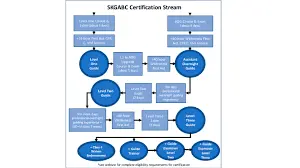
Progression through the Paddle Colors: six skill levels from beginner to expert
The Euro Paddle Pass recognises practice levels internationally. It came out of collaboration between several national federations (FFCK, British Canoeing, federations of Germany, Sweden, Switzerland, Ireland). By creating a "common language" for navigation, safety and environmental management skills, the system aims to make it easier for practitioners to move between countries.
| Level | EPP Color | Key Skills | Access Condition |
|---|---|---|---|
| Level 1 | Yellow | The end of initiation: balance, basic safety, and capsizing without panic | Initiation course completed |
| Level 2 | Green | A 2h flatwater trip, 200m of propulsion, a stop in 4 strokes, and reverse paddling | Level 1 validated |
| Level 3 | Blue | Autonomy in a group, self-rescue and use of specialized equipment | Level 2 validated |
| Level 4 | Red | Leadership, an autonomous Eskimo roll and group management | Level 3 validated + experience |
| Level 5 | Black | Total expertise, confident exploration and complex management | Level 4 validated + complete mastery |
An evaluator for Level 1 needs at least a Level 2. From Level 3 onwards, coach and evaluator must be different people, to guarantee impartiality. At the expert levels (4 and 5), the evaluator must hold Level 5 and have specific training from their national federation.
ADEPS (General Administration of Sport) structures the training of kayak instructors in French-speaking Belgium, working with the Francophone Canoe Federation (FFC). The Belgian system has four levels of sports instructor, each with specific responsibilities and technical prerequisites.
State diplomas registered with the National Directory of Professional Certifications (RNCP) are open to kayak professionals in France. These qualifications guarantee safety and pedagogical skills, and they allow paid professional practice.
| Diploma | RNCP Level | Main Function | Indicative Duration |
|---|---|---|---|
| CQP Monitor | - | Flatwater initiation / 300m sea | Variable |
| BPJEPS | Level 4 (High School) | Sports educator / Autonomous instructor | 12-18 months |
| DEJEPS | Level 5 (Bac+2) | Coach / Project coordinator | 18-24 months |
| DESJEPS | Level 6 (Bac+3) | Director / Technical advisor | Varied |
The hierarchy of professional kayak diplomas in France
Whitewater rescue goes beyond pure navigation technique and falls under specific, globally recognized certifications. River guides, instructors and practitioners who venture into hostile environments need these trainings.
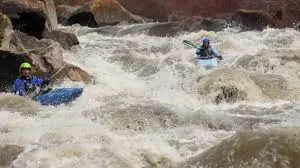
Rescue 3 and LFBS: the international whitewater rescue standards
Regulatory constraints also apply to kayaking on large bodies of water or in maritime zones. In Belgium, the Federal Public Service (SPF) Mobility issues mandatory operating certificates, which depend on the use and on the type of support craft.
| Navigation Zone | Required Certificate | Scope / Conditions |
|---|---|---|
| Zone 1 | Restricted | Inland waters (rivers, canals) |
| Zone 1-2 | General | Inland waters + 6 nautical miles coast |
| Zone 5-6 | Yachtsman | 6 to 200 nautical miles |
| Zone 7 | Yacht Navigator | Beyond 200 nautical miles |
How skills are evaluated differs greatly with the chosen specialty. Here are the main criteria for the major disciplines.
Navigation: Being able to navigate at all speeds in a force 3 wind. Safety: Building a navigation plan that takes in wind, swell, current and tides. Prerequisites: Navigating at least 2 different sites, 5 miles each, in slightly rough seas.
Maneuvering Course: Dribble 20m without deviation >45°. Rotation: 180° turn with engagement. Shooting: At goal 5-10m with significant speed. Endurance: 4 x 300m with consistency ±10s.
Physical Knowledge: Describe changes in water color/turbidity. Ecosystems: Naming 2 types of habitats and justifying why they should be preserved. Legislation: Defining the legal status of a site and what it means for accessibility.
Technical evaluation criteria for canoe polo and specialized disciplines
The kayak certification system is designed as a progressive ecosystem. A beginner can validate a White Paddle and progress to a Confirmed Blue Paddle in autonomy, then branch off into professional supervision through the BPJEPS to become an instructor. Safety standards and environmental competency are maintained at every stage.
The progression path, from recreation to professional supervision and expertise
Within 6 months of obtaining the CQP Monitor, 90 to 100% of holders are in employment. The BPJEPS opens up employment prospects in leisure centers, clubs, kayak schools and tourist structures in the Ardennes and beyond.
How kayak levels are structured shows a desire to balance freedom of practice with safety imperatives. The Euro Paddle Pass unifies Europe and offers practitioners unprecedented fluidity, while the rigor of French State diplomas and Belgian ADEPS certificates guarantees high-quality supervision. Future developments will likely bring stronger integration of environmental issues (Natura 2000 protection, water quality monitoring) and hybrid training that combines theoretical e-learning with intensive hands-on immersion internships.
Federations put the kayaker at the center of a certified skills ecosystem, and this secures the sustainability of a sport whose vitality relies on the encounter between human technique and the force of natural elements. If you aspire to progress recreationally or to become a professional instructor, the certification system gives you a structured, recognized and reassuring pathway.
No. For guided tourist descents on the Semois, the Lesse or the Ourthe, no certificate is required : you simply need to know how to swim and follow the safety instructions at departure. A certification is only required for sport whitewater in a club or in competition.
Three simple benchmarks : beginner (never or rarely paddled → calm rivers like the Semois), intermediate (comfortable on flat water, a few class I-II rapids → Lesse, Ourthe), advanced (mastery of manoeuvres in the current → Amblève, class II-III). When in doubt, always choose the lower level.
The minimum age ranges from 6 to 8 years depending on the route and the flow of the day. A normal physical condition is enough for family routes ; long descents (15 km and more) require some endurance. Children paddle in a two-seater with an adult.
Yes. The buoyancy aid is provided and mandatory for everyone, regardless of your swimming level. It must be worn and properly adjusted throughout the descent.
With the clubs affiliated to the federation (LFCK / ADEPS in French-speaking Belgium), which deliver the « colour paddles » and whitewater training. Our tourist descents, however, require no certificate.
It is not advised on routes with current. On calm water and with a life jacket, a guided descent remains possible, but mention it at departure : you will be directed to the safest and most suitable route.
« A perfect family day on the Semois. The welcome at Kayak Belgique is warm, the equipment is spotless (the kayaks are modern and clean), and the free shuttle system is superbly organised. A must-visit in the Ardennes! »
« Beautiful kayak trip on the Semois starting from Vresse! Very friendly staff and excellent shuttle service. The riverside campsites along the Semois are also a must for nature lovers. »
« Superb 11 km kayak descent starting from Alle-sur-Semois. The wild nature of the Ardennes is magnificent in the spring sunshine. Very competitive prices compared to the competition. We'll be back! »
« Wonderful experience! The kayak tour on the Semois was perfectly organised. The team is very helpful and speaks good German. The scenery of the Belgian Ardennes is simply breathtaking. »
« Excellent kayak rental service and great campsite on the banks of the Semois. The prices are very fair and the atmosphere is friendly and family-oriented. The little terrace bar is perfect for a refreshing drink after the effort. »
« A fantastic last-minute welcome even though we hadn't booked in the middle of August. Life jackets and waterproof barrels are provided free of charge. Very safe descents, ideal with children! »
« Top-tier kayak rental on the Semois river. Extremely friendly staff, well-maintained kayaks, and a reliable shuttle. The viewpoints along the river are absolutely stunning. Highly recommend this local business! »