Jean-Luc Demaret G
« A perfect family day on the Semois. The welcome at Kayak Belgique is warm, the equipment is spotless (the kayaks are modern and clean), and the free shuttle system is superbly organised. A must-visit in the Ardennes! »
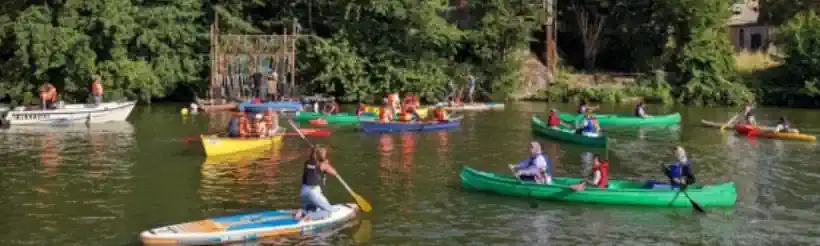
The people's descent, competition disciplines, Walloon paddling heritage and the calendar of water festivals: a complete guide to enjoying the Semois in festive mode, with the family and with respect for the National Park.
↓ Scroll down
Audio documentary: the spirit of the water festivals
A short piece to set the mood of the valley
In the Ardennes valleys a “kayak festival” is less a ticket office than a tradition. It is the time of year when people paddle the river together, with no stopwatch, for the sheer pleasure of it, a picnic on a pebble beach and a finish on a village terrace. This is the festive, family side of a sport that also has a competitive one.
The kayak festival grows out of a specific heritage. From the end of the 19th century the river was more than a channel for floating logs or watering tobacco fields: it turned into a playground. The first rowers met on the Meuse and the Lesse, and “descents” became collective gatherings. To this day the Lesse descent, practised for over a century, remains the emblem of this popular culture, and the Semois is its wilder, slower sister.
Conviviality over performance
There is no ranking and no bib number. Everyone keeps to the group's pace, helps the others across the shallows and shares the picnic.
A framework for learning
For many beginners the festival is a first outing, with a briefing, basic technique and guides on the water.
An act of ecotourism
Since the listing as a National Park, and the collective descent follows a charter: silence near nests, no litter, marked rest beaches.
A kayak festival can add playful events beside the people's descent, inspired by the disciplines the International Canoe Federation (ICF) recognises. On the calm, shallow Semois we favour accessible formats, whereas the whitewater formats suit the Amblève or to artificial basins.
The descent (wildwater race)
A timed event on a fast section, where you hunt for the most powerful line of water. It is the flagship discipline of Walloon competitive kayaking; see Jean-Pierre Burny below.
Slalom
The course is 200 to 300 m long, marked by green gates (taken downstream) and red gates (paddled back up). Precision and reading the water count for more than power.
Kayak cross
Four paddlers start together from a ramp, clear gates and must perform an Eskimo roll. It is spectacular but reserved for purpose-built water.
Sprint & marathon
Sprints are raced over 200 to 1000 m on flat water, while the marathon runs beyond 20 km with portages. The Lesse marathon was among the first Ardennes races.
Freestyle
Acrobatic tricks performed in a fixed hole. It needs a wave or a drop, so it is impossible on the Semois in low water but possible in high water.
Canoe polo, dragon boat & SUP
These are the collective, festive formats par excellence: a polo tournament on calm water, a dragon boat with synchronised paddling, and stand-up paddle as a gentle introduction.
At a village fair, these disciplines become water games: barrel relays, paddle “jousting”, a skill course between buoys and family-canoe races. The point is laughter and discovery rather than the podium, making it an ideal gateway to structured learning or to the kayak school.
The kayak festival of today continues a long history, Arctic first and Ardennes later. Knowing its milestones gives more depth to each stroke on the Semois.
The craft first appeared more than 4,000 years ago in the circumpolar regions, with the Inuit qajaq, a frame of driftwood or whalebone covered with sewn, greased sealskins, weighing about fifteen kilos and allowing a silent hunt. The word “kayak” reached French in 1765, carried back by Arctic explorers, and sporting use followed in the 19th century.
In Wallonia the cradle is the confluence of the Meuse and the Lesse. From the 1870s rowers gathered on the Island of Love in Anseremme; the painter Félicien Rops chaired the Cercle Nautique de Sambre & Meuse founded in Namur in 1862. In 1909 the Royal Cercle Nautique Meuse et Lesse was born in Anseremme, with speed races and then marathons on the Lesse between Wanlin, Villers and Anseremme. The club organised the Belgian speed championships in 1949, and the Centre nautique dinantais was inaugurated in 1973.
Jean-Pierre Burny, born in Anseremme in 1944, is still the legend of Belgian kayaking: four-time world wildwater descent champion (Bourg-Saint-Maurice 1969, Muotathal 1973, Skopje 1975, Debiens 1979), a finalist at three Olympic Games and inducted into the International Whitewater Hall of Fame. An entire generation of Ardennes people learned to paddle in his wake.
— History of the Walloon descentFour technical breakthroughs made the kayak a mass leisure activity:
Inuit invention of the qajaq
The closed hull and the Eskimo roll appear.
Fibreglass
It was light for racing but too fragile for intensive rental use.
Rotomoulded polyethylene
A hull that is nearly indestructible against the schist opens the descent to beginners and children. This is the true democratisation.
Carbon, Kevlar & self-bailing hulls
High performance on one side, comfort and safety on the other: ergonomic seats, footrests and reinforced buoyancy.
Semois Valley National Park
The descent becomes regulated ecotourism, and the kayak festival is now planned with the wildlife rather than against it.
To go further: our history of the kayak and the Tobacco Route page, which describes the valley as it was before the kayaks.
The “kayak festival” rarely stands on its own, since it slots into the valley's summer diary. These are the dates around which to plan a paddle and terroir weekend. Check the dates with the tourist offices every time, because they change from year to year.
"L'eau en fête" in Vresse-sur-Semois
The flagship event is organised by Le Delta (the province of Namur's cultural centre) with the municipality and the tourist office. On Vresse beach and Place Cognaux it offers creative workshops (recycled instruments, land art, cyanotype), storytelling walks, an animated film, contemporary dance with saxophone and a folk ball, then closes at around 10.15 pm with a show combining water and fire. Free admission, for all ages.
The Tripel Beer Festival
Ardennes brewing know-how takes centre stage, so an afternoon descent can be paired with an evening tasting. Extend it with our Semois cheese & honey page.
Celtivales & the Bouillon Medieval Festival
Celtic music, followed by a historical re-enactment at the foot of the castle. Kayak in the morning from Bouillon, festival in the afternoon.
Craft markets & village fairs
Corbion, Poupehan, Rochehaut and Alle each have their own fair, chip shop and terrace. It is the best time to stumble on an impromptu people's descent.
Kayak Belgique sets its "Kayak Festival" day on the second weekend of June, when the Semois still flows generously and the vegetation is at its peak. The descent is untimed and the price stays that of the chosen route, and the festive day is free.
Every edition has its own character, but the day of a kayak festival on the Semois runs roughly like this. Use it to plan your accommodation and meal bookings.
Welcome & coffee at the Alle base
Sign-in, choice of craft (single, double or family), life-jacket fitting and a complimentary Ardennes coffee.
Collective safety briefing
How to read the river, what to do in a capsize, exit points and National Park guidelines. See weather & safety.
Departure in waves
Groups of 8 to 12 kayaks leave every ten minutes, with guides at the front and the back. Passing under the Pont de Claies if the level allows.
Picnic on the beach
Regroup at a fitted put-in area (picnicking is forbidden elsewhere). Swim freely in water of 18–22 °C in June.
Water games & workshops
Paddle jousting, a skill course, an Eskimo-roll taster for the curious and a “reading a river” workshop for children.
Arrival & return shuttle
Take-out, then a minibus back to the cars, with showers and changing rooms at the base.
Terrace & terroir in the village
Local beer, ham of the Semois, home-made tarts. If the diary lines up, there is also the “L'eau en fête” concert in Vresse.
The kayak festival falls at the start of summer for a reason: this is when the river is at its most beautiful and most navigable.
The "white carpets" of water-crowfoot. From June to August, water-crowfoot (Ranunculus) flowers in wide sheets of white blooms with yellow hearts, a few centimetres above the water. These water plants oxygenate the river and shelter fry and invertebrates, so you paddle through them and never tear them out. They are the visual signature of early-summer descents.
The Pont de Claies is built in June. At Laforêt, between Alle and Vresse, villagers rebuild an ephemeral footbridge of oak, beech, hornbeam and hazel each year “as soon as the level of the Semois is low enough”. It is a legacy of the tobacco economy (1850–1860) and is dismantled every autumn, giving the festival a unique backdrop.
Flow, the deciding factor. Navigation opens when the flow lies within the window set by the Walloon Public Service. Below it, a “drought” closure protects the riverbed and wildlife, and above it a “flood” closure protects people. Check the real-time water level and the table of SPW thresholds before you book.
The weather. June in the Ardennes brings cool mornings, mild afternoons (20–24 °C) and a risk of storms late in the day. Set off early and pack a windproof layer. See when to kayak on the Semois.
You need no licence and no personal equipment, because the kayak festival is designed for the uninitiated. Here is how to get organised.
1. Book early
Equipment goes quickly on weekends from June to August. Book 10 to 15 days ahead, preferably online, to secure the kayak model and the time slot.
2. Choose your route
Alle → Vresse (7 km) for families, Poupehan → Alle (10 km) for a first taste, Alle → Bohan (17 km) for the full day. Use the route quiz or the descent duration page.
3. Pack your bag
Closed shoes, swimwear, a windproof layer, sun cream, 1.5 L of water and a snack, all packed in the watertight barrel we provide. Full list: our checklist.
Prices & groups. Joining the festive day costs nothing. Only the descent is charged, at the usual rate for the route (from €26.40 per person, shuttle included). A works council, school class or birthday can book the kayak festival privately: see teambuilding & seminars and the youth kayak school.
Safety. Life jackets are compulsory for under-12s and non-swimmers, and we provide and fit them. If a weather alert or an SPW closure occurs, the outing is postponed or refunded in full; details on the weather, safety & cancellation page.
Paddling down in several dozen kayaks has an impact. In the National Park and in a Natura 2000 zone, the kayak festival comes with simple rules that are not up for negotiation.
This ethic takes nothing away from the festival. It makes sure a living river is still there to celebrate next year, and it fits with our ecotourism strategy.
The valley fills up from mid-June, so book your accommodation at the same time as your kayaks.
Camp as close to the water as possible. The campsites of Alle-sur-Semois and Vresse-sur-Semois put the base within walking distance. Full overview: where to camp and the campsite guide. Motorhome area.
Cottages, rooms & hotels. Rochehaut, Corbion and Bouillon gather the quirky and comfortable options: where to stay in the valley.
Eat local. The Poupehan chip shop, the terraces of Alle and Vresse, and terroir tables: ham of the Semois, trout, cheese and valley honey.
Extend the stay. Itinerary ideas: Semois weekend, GR16 walks, most beautiful villages, the Alle slate quarries, natural swimming.
Book your descent for the next edition and see the valley at its most convivial, whether with family, friends or as a group.
🎟️ Book my descent« A perfect family day on the Semois. The welcome at Kayak Belgique is warm, the equipment is spotless (the kayaks are modern and clean), and the free shuttle system is superbly organised. A must-visit in the Ardennes! »
« Beautiful kayak trip on the Semois starting from Vresse! Very friendly staff and excellent shuttle service. The riverside campsites along the Semois are also a must for nature lovers. »
« Superb 11 km kayak descent starting from Alle-sur-Semois. The wild nature of the Ardennes is magnificent in the spring sunshine. Very competitive prices compared to the competition. We'll be back! »
« Wonderful experience! The kayak tour on the Semois was perfectly organised. The team is very helpful and speaks good German. The scenery of the Belgian Ardennes is simply breathtaking. »
« Excellent kayak rental service and great campsite on the banks of the Semois. The prices are very fair and the atmosphere is friendly and family-oriented. The little terrace bar is perfect for a refreshing drink after the effort. »
« A fantastic last-minute welcome even though we hadn't booked in the middle of August. Life jackets and waterproof barrels are provided free of charge. Very safe descents, ideal with children! »
« Top-tier kayak rental on the Semois river. Extremely friendly staff, well-maintained kayaks, and a reliable shuttle. The viewpoints along the river are absolutely stunning. Highly recommend this local business! »