Claudia Mink G
« Excellent service d'hydrologie, tenu informé en temps réel des statut de navigation »
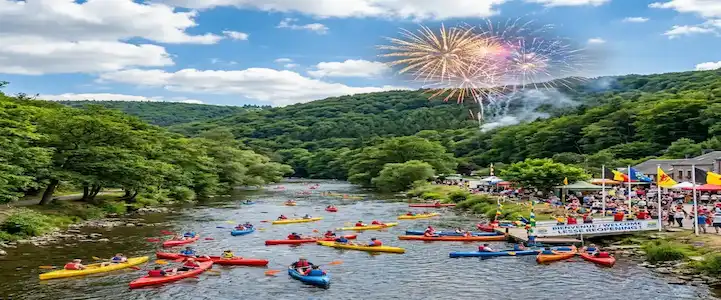
News that came as a real relief across the Dinant and Houyet region: kayaking is officially open again on the Lesse. It ends an exceptionally long dry spell. Indeed, it had been completely impossible to kayak since July 9 — weeks of frustration for holidaymakers and anxious watching for lovers of Ardennes nature. Today the water has passed the critical threshold that allows boats back onto this emblematic river of the Namur Ardennes. Also see our Lesse vs Semois comparison to decide which river best suits you.
The summer that has just ended will go down in the meteorological and hydrological records of the Walloon Region. The navigation ban, issued on July 9, lasted longer than even the oldest residents can remember. The drought was not only severe but persistent: it blocked any significant flow from the Ardennes tributaries. The Semois and the Amblève were affected too, although these rivers held up better because of their different hydrographic profiles.
The Lesse catchment, which covers nearly 1,346 km², reacts particularly fast to rainfall conditions. Unlike rivers fed by snowmelt or large deep aquifers, the Lesse depends closely on regular rain and on the shallow groundwater of the Ardennes forest massifs. Since mid-June, a persistent anticyclone has blocked Atlantic depressions and plunged Belgium into a major rainfall deficit. The base flow — the minimum flow sustained by groundwater — dropped dangerously under the combined effect of successive heatwaves.
On July 9, the flow measured at the official Gendron station (SPW Hydrometry, station 8221) fell below the fateful 1.5 m³/s mark. At this critical level, regional regulations are clear: navigation is suspended. This protective measure, however frustrating for local tourism, is vital for two reasons:
Thanks to the welcome rain of the last 72 hours, the flow of the Lesse is currently 2.23 m³/s. This figure sits ideally within the authorised navigation range. For canoes and kayaks to be admitted on the Lesse, the Public Service of Wallonia (SPW) requires a flow between 1.5 m³/s and 52.0 m³/s. We are right in the optimal window: the "Very Calm" level suits beginners and families perfectly.
The official data from SPW station 8221 at Gendron confirm that the navigable area is only partly open: only the short route starting from Gendron (12 km) is authorised and secured. The long route starting from Houyet remains closed for now. The return shuttle runs for the 12 km section.
With a flow of 2.23 m³/s, it is the Green Flag that flies over the landing stages. This regulatory signal sets out the access conditions and the rules to follow:
If the closure disappointed tourists’ urge to get out on the water, it paradoxically gave the Lesse valley ecosystem a vital, unexpected respite. This rest perfectly illustrates the “resting pressure” concept that scientists of the Natura 2000 network observe on Ardennes rivers.
Without the daily passage of hundreds of plastic hulls, the shallow waters and spawning grounds regained absolute calm. The populations of white-clawed crayfish (Austropotamobius pallipes), a protected species found on some sections, also benefited from this precious lull. Without human noise, emblematic birds came back, such as the Common Kingfisher and the elusive Black Stork, spotted foraging in the calm water.
Even though Wallonia has other magnificent rivers — the Semois, the Amblève, the Ourthe — the Lesse holds an almost mythical place in the Belgian collective imagination. This long wait has only multiplied the urge to get back on it.
The Lesse carves its bed through the Condroz geological massif, resulting in monumental limestone cliffs and the famous Chaleux Needles, listed as Exceptional Heritage of Wallonia. Paddling at the foot of these colossal rock formations brings a feeling of humility and escape worthy of the great European canyons, only a few kilometres from Namur.
During your route you will pass beneath the dizzying foundations of Walzin Castle, perched on its rocky spur that rises sheer above the river. It is one of the most photographed castles in Europe. From a kayak, at water level, the view is unrivalled, especially in the good season.
After such a long period of inactivity, the urge to rush onto the water is natural. Yet only a well-prepared descent guarantees a successful day. Also see our complete checklist of gear to bring before you leave.
With a flow of 2.23 m³/s, depth can be limited to a few tens of centimetres in the wide areas. It is perfectly normal to scrape the bottom slightly in some shallow sections.
See our full prices and our comparison of rivers, routes and Ardennes tips to plan your trip well.
From July 9, the Lesse was closed to kayaking because of an exceptional drought that brought the flow below the minimum regulatory threshold of 1.5 m³/s set by the SPW (Public Service of Wallonia). Below this threshold navigation is prohibited, to protect fish spawning grounds (grayling, barbel, trout) and to guarantee the safety of paddlers.
Yes, the Lesse is currently navigable: the flow reaches 2.23 m³/s at the SPW station in Gendron (station 8221). The authorised regulatory range runs from 1.5 m³/s to 52.0 m³/s. The river is rated “Very Calm”, green flag: ideal for all levels and for families with children from 5 years old.
Under the green flag, the whole Lesse network is open. The two main routes are the classic Gendron → Anseremme (12 km, 2h30 to 3h, very easy, ideal for families) and the long descent Houyet → Anseremme (21 km, 4h30 to 5h30, medium level, a full day passing through the Furfooz Nature Park and the Chaleux Needles).
This period of drastic restriction, in force since July 9, will remain etched in the memory of everyone who loves the Namur river. Today the Lesse flows again, generous and welcoming. Condroz cliffs, the discreet song of the white-throated dipper, the controlled adrenaline of the Walzin chutes and the green immensity of the Ardennes forest: everything awaits you. Make the most of this ideal meteorological and hydrological window. Grab your paddles, and enjoy your descent, everyone! 🛶🌊
« Excellent service d'hydrologie, tenu informé en temps réel des statut de navigation »
« Un endroit magnifique, calme et apaisant... De belles rencontres et des points de vue féerique ✨ je recommande vivement pour ce ressourcer et ce reconnecter à la nature 🍄🟫 »
« Rendez vous vite sur ce lieu pour un super moment en famille ou entrés ami(e)s ... Expérience géniale ! »
« très bon site »
« Super lieu, et très bon accueil Je recommande ce lieu 😉 »